
Perceivable
Information needs to be available in forms blind and low-vision users can perceive, not trapped inside visual layouts, scanned images, or inaccessible presentation.
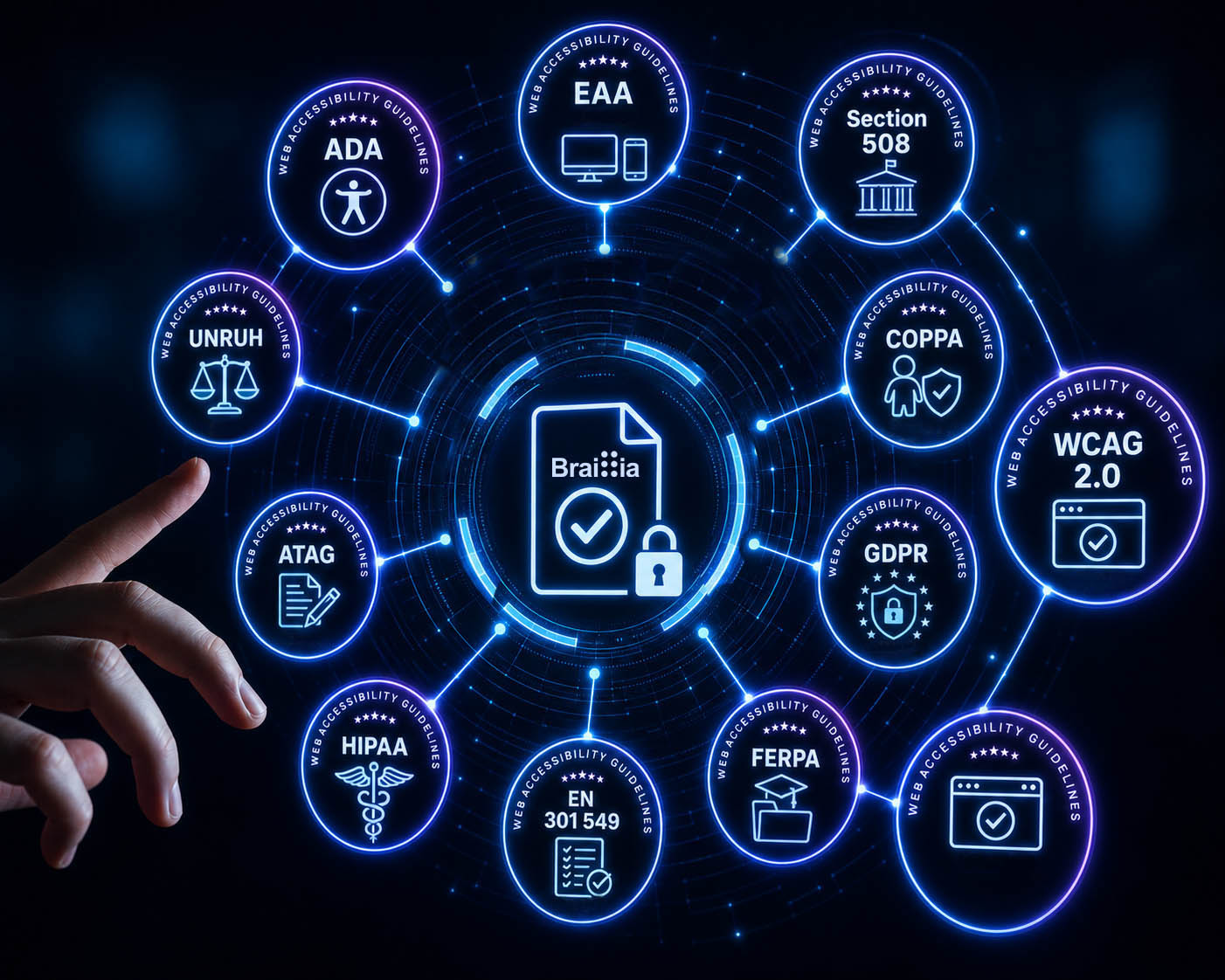
Illustration of a Braillia compliance document connected to accessibility, privacy, and security standards including ADA, Section 508, WCAG, EN 301 549, GDPR, HIPAA, FERPA, and EAA.
ADA / WCAG / Section 508 / EN 301 549
WCAG, Section 508, ADA programs, EN 301 549, document accessibility, assistive technology compatibility, and validation workflows all point toward the same operational outcome: people must be able to receive, understand, navigate, and act on information. Braillia is the accessibility delivery network built around that outcome.
Braillia network fit
Accessibility requirements, privacy governance, and secure delivery connect through the Braillia accessibility network.
What the standards require
WCAG organizes accessibility around four principles: information must be perceivable, operable, understandable, and robust. Section 508, ADA programs, and EN 301 549 use those principles to shape real obligations for electronic content, web content, mobile apps, documents, ICT products and services, and assistive technology access.
Information needs to be available in forms blind and low-vision users can perceive, not trapped inside visual layouts, scanned images, or inaccessible presentation.
Navigation, controls, reading flows, links, and document movement need to work without relying on sighted-only interaction patterns.
Users need clear structure, predictable movement, readable language, and enough context to understand what information means and what action may be needed.
Content should be structured so assistive technologies, accessible readers, mobile experiences, and future systems can interpret it reliably.
Compliance drivers
Organizations need accessible content, accessible software, accessible documents, and accessible communication workflows. The hard part is doing that repeatedly across departments, file types, delivery channels, urgent communications, and user needs.
Braillia is designed for that operational layer: the network that moves inaccessible or hard-to-use communication into structured, guided, mobile-accessible experiences.
Perceivable, operable, understandable, and robust access to digital content and interfaces.
Accessible covered electronic content, including electronic documents and software used by federal agencies.
WCAG 2.1 Level AA expectations for state and local government web content and mobile apps.
European ICT accessibility requirements used in public-sector procurement and digital accessibility programs.
Reading order, headings, lists, tables, link purpose, metadata, language, and meaningful alternatives.
Compatibility with screen-reader, keyboard, mobile accessibility, and structured reading workflows.
Access that lets people receive and use important information in a format that works for them.
How Braillia fulfills the operational need
The Braillia network sits between organizational communication systems and blind and low-vision users. It coordinates secure delivery, accessibility processing, AI-assisted understanding, mobile reading, reminders, messages, and operational controls so accessibility can move in real time.
Requirement
Accessibility requirements depend on content that can be interpreted, navigated, and transformed instead of remaining locked in a visual-first document.
Braillia network fit
Braillia ingests documents, notices, messages, and printed information, then structures content for accessible mobile reading, search, organization, and Braillia AI Personal Assistant support.
Requirement
People need timely access to current information, especially when the communication involves healthcare, billing, service, benefits, legal, or safety consequences.
Braillia network fit
The Braillia network supports secure QR pickup, messages, notifications, reminders, and guided mobile access so users can receive information when it matters.
Requirement
Accessible information should be understandable enough for users to identify key details, deadlines, instructions, changes, and next steps.
Braillia network fit
Braillia AI Personal Assistant helps users ask natural questions, summarize communication, surface important details, and understand what action may be needed.
Requirement
Organizations need governance, repeatable workflows, secure delivery, and visibility as accessibility work moves beyond one-off document repair.
Braillia network fit
Braillia connects portal delivery, APIs, QR workflows, Company Admin controls, branding, user management, and secure cloud orchestration into one accessibility delivery network.
Document requirements
Tags, reading order, headings, tables, alternatives, language, metadata, and link purpose matter because they help users and assistive technologies understand the document. Braillia carries that same goal into a guided mobile delivery experience.
When organizations maintain formal document validation workflows, Braillia carries the access path forward into secure delivery, mobile understanding, reminders, and guided user action. The Braillia network’s core role is to make the information usable at the point of need.
European and privacy context
EN 301 549 extends accessibility expectations into European ICT procurement and product/service accessibility. Braillia supports the same practical outcome by connecting documents, messages, QR delivery, AI-assisted understanding, mobile access, and organizational controls into one accessibility delivery layer.
GDPR is a privacy and data protection framework rather than an accessibility standard. Because accessible delivery often involves sensitive documents and personal information, Braillia treats privacy, security, access control, retention, and governance as part of the network trust model.
The usable outcome
Braillia helps organizations move from prepared content to usable communication: the user receives the information, understands what matters, navigates it independently, asks questions naturally, and takes action with more confidence.
Requirements define the baseline. Usable access is the outcome Braillia is built to deliver.
Go deeper
Explore why technical conformance should lead to independent real-world use for blind and low-vision users.
These links are useful context for accessibility teams.
Buyer questions
Braillia helps organizations turn prepared information into a practical delivery workflow for real-time BLV access.
Braillia strengthens accessibility programs by adding the operational delivery layer: accessible information blind and low-vision users can receive, understand, navigate, organize, and act on in real time. It supports web, mobile, document, procurement, and communication work by turning accessibility requirements into usable communication outcomes.
Braillia transforms document information into structured, guided mobile experiences with navigation, search, reminders, and Braillia AI Personal Assistant support, giving organizations a real-time delivery and understanding layer for important communication.
EN 301 549 fits directly into accessibility and ICT procurement alignment. Braillia supports the practical accessibility outcome behind those requirements by helping organizations deliver structured, navigable, understandable mobile access to important information.
GDPR is a privacy and data protection framework, not an accessibility standard. Braillia addresses privacy-related needs through security, governance, data handling, role-based access, retention-aware workflows, and platform privacy controls that are covered more deeply in the Platform Security page.
Let us show your team the power behind Braillia's backbone document delivery.